Showing posts with label Philippines. Show all posts

Thursday, 7 October 2010

Chicken Ham - Sensation!


I don't know if you've ever eaten petto d'oca, smoked goose breast; it is seriously delicious and good, and puts mere pork ham in the shade. I used to make a trip to a special shop to buy it every time I visited Italy.

So I decided to try a different version; smoked chicken. I bought a plump one, de-boned and quartered it, (see http://www.youtube.com/watch?v=YzmjtTUQS6g & http://www.youtube.com/watch?v=QFjFtMA-TJE&feature=related) then soaked it in a strong brine for 4 hours.

Tuesday, 26 August 2008

Tsunami Notice

Tsunami notice from Siargao Island, NE Mindanao, Philippines, home of Cloud 9 surfing spotStrange thing, you know; since the Big Tsunami in the Indian Ocean on December 27 2006 (my birthday, as it happened) everyone has got all concerned.

It's fairly obvious that, on an island like Siargao, where most of the flat ground is only 1 or 2 metres above high-tide mark, that, if a tsunami happened, we'd all be done for.

A tsunami's not something you can plan ahead for.

We're only a few miles from the Philippine Deep (some 10km down), and if, say, a huge submarine landslide or something similar happened there, we wouldn't have much time to run.

Tsunami notice 2 from Siargao Island, NE Mindanao, Philippines, home of Cloud 9 surfing spotSo there's not much point in putting up notices like this, especially when it's distinctly ambiguous about whether you have to run 14 kilometres or just a mile.

So, it may happen at any time, and since I can't run much any more, I'll just plod along, and pray (even though I'm an atheist).

Friday, 22 August 2008

Siargao Zingiber Project 2 - Etlingera fimbriobracteata

iuEtlingera fimbriobracteata from Siargao Island, NE Mindanao, Philippines, home of Cloud 9 surfing spotRon was the first to find one of these local ginger plants, and I wrote about them here.

I didn't realise at that time quite what a very strange plant this is.

If you look closely, you'll see a nascent bud to the left, a bud with about six yellow and red flowers open in the middle, and, to the right, what is presumably the next stage, a sort of mini-pineapple with the petals withered, and pink fruit developing.Etlingera fruit body split from Siargao Island, NE Mindanao, Philippines, home of Cloud 9 surfing spot
etlingera ginger fruit from Siargao Island, NE Mindanao, Philippines, home of Cloud 9 surfing spotNow, we haven't been watching these plants closely enough. (I've transplanted a few to my garden, where we can keep a eye on them).

Suddenly, at the next stage, they produce fruit, about 3 metres up, on long stems.

What's going on? How, exactly, does that mini-pineapple transform itself into a ten-foot fruit-bearer?

The only answer is to camp out next to one of the mini-pineapples, and photograph it, every hour, through the night.

Ron - get your sleeping-mat ready!


Update: 24/8/08. I was completely wrong on all of this. The small pineapple does NOT suddenly transform into fruit 10 feet above it, Instead, it's a different, but related plant that happened to grow in the same place, called Alpinia haenki (or macassarensis), which is even more rare.

Wednesday, 20 August 2008

Coconut Harvest

coconut harvest from Siargao Island, NE Mindanao, Philippines, home of Cloud 9 surfing spotThis is the usual three-monthly coconut harvest from the sixteen trees in my garden. The usual haul is 5 sacks, each of about 25 kilos kopras meat (about 100 pieces per sack).

It's a wonderful, bountiful tree - see: Coco Loco

climbing coconut tree in Siargao Island, NE Mindanao, Philippines, home of Cloud 9 surfing spotIt does everything you can think of, except, possibly, marriage guidance, but it's almost certainly got a secret chemical that will help with that kind of problem.

One brave fellow climbs the trees and trims off the ripe coconuts, and they come crashing down like small bombs.Lugit man shelling coconuts  Siargao Island, NE Mindanao, Philippines
Then they chop the whole nuts in half, and scoop out the meat with a specially-shaped knife, a lugit.
tapahan copra drying house from Siargao Island, NE Mindanao, Philippines, home of Cloud 9 surfing spot


The meat is now kopras, but it has to be dried first, in a tapahan, which is really a bodged-up smokehouse, like this. The smouldering coconut husks are used for fuel, and the process takes most of a day.

I've often wondered why the operators of the tapahan don't also use the process to cold smoke a few fish or sides of pork, but perhaps they've never thought of it

Monday, 18 August 2008

Fidelity - Female Fruit Flies Only Fuck on the First Date

fruti flies matingI'm not a lot interested in fruit flies, as such, but they (Drosophila) have been a great deal helpful to science in general and especially in the genetics corner.

It seems that female fruit flies are fussy. After the first time they have intercourse, they don't want to do it again.

Someone has discovered (or thinks he has) how.

Now this is how you find out the the details of the complicated and devious mind of the female fruit fly.

You feed them. With yeast that contains lots of heavy nitrogen. That isotope labels all of the female proteins.

Then you look at them after they've fucked. Anything that didn't have the heavy nitrogen was given by males. The researchers discovered some sixty-three proteins from fruit fly semen, which may suggest that the male fruit fly lacks confidence in his wife's fidelity, and is over-doing it a bit.

(Sorry to anyone who's offended by the fffour-letter word - the alliteration was just too good to resist).

Saturday, 16 August 2008

Siargao Zingiber Project - Sidelining

For the first time, I got up off my bum, and went myself with my crew (Ron & Shedney), to find some new and exotic ginger plants reasonably nearby.
We went to Victor's Flying Fox Bar, built, like only a total crazy could do, out in the boonies, opposite a perfect jungle mountain, where the flying foxes do a grand fly-past every evening, dead on time at 2.5 minutes past dusk.

We walked along the edge of the mountain, and we did find a couple of new ginger plants (which I'm waiting to have identified).
But, more than that, we found some other strange plants that I don't have much of a clue about:

This is wild ubi, a purple yam, that, domesticated, is a great favourite here in the Philippines. It's even a top flavour for ice cream. Purple ice cream? It's delicious. Only in the Philippines.

puso banana buds siargao island philippinesAnd we found these, abandoned: Puso banana buds, but only the stripped skins, the buds taken off to make into a fabulous salad.

And then this one, known locally as padjaw. It's an aroid, but I don't know much more about it, and I don't know why it grows 'pretend peppers'.
padjaw aroid plant Siargao Island Philippines

Siargao Zingiber Project - 1

Following on from my Pano'on 1 and Pano'on 2 posts, I've got all enthused about ginger plants.

It seems, according to John Mood, a 20-year expert on ginger (Zingiber) plant taxonomy, that we may just have a new species on our hands.

Here, it's called kayaskason, and it's very common. John asked me to preserve the leaves and inflorescence (a la herbarium, pressed between newspaper sheets). This is a bit difficult, because we don't get newspapers hereabouts, and the big fruits don't really press very well.
However, I'll do my best.

I proposed, very strongly, based on the first specimens that Ron brought to me, that the damned plant didn't have flowers.

But it does.

Here's a picture of one, a bud popped into a vase of water at 5pm and open and greedy at 7pm.

I'm not a botanist, so I really didn't know that my photo was upside down.

It looked extraordinarily like the face of one of the local horseshoe bats. Even down to the two very small 'eyes' either side of its 'nose'.

Now, if I was a bat, I'd visit this flower, and land on the strong stem just behind it. Then I'd bend over, and find I was facing the thing upside down. I would be doing 69 face to face with a friend from another biological kingdom.

Probably, I'd lap up all the ants crawling around the nectar, and then lap up some of the delectable stuff for myself.

Friday, 15 August 2008

Morning Bakery

morning bakery of fresh bread at Bebot's Siargao Island PhilippinesEvery morning at 5am, as the sun rises, reluctantly, Bebot's wife makes bread rolls, and they're wonderful.

They're not the usual Philippines pan-de-sal, that are altogether too sweet and mushy. These are almost genuine, unsugared, bread rolls.

I buy them for breakfast (for dunking in coffee or Milo) or even, sometimes, as a special 'English' treat (sliced hot with plenty of butter and a bit of Marmite).

The oven is very high-tech. It's a galvanised iron box, with a folded corrugated-iron roof folding over. This one even has a heat shield at the front. It's fired by a pile of smouldering coconut husks on top. Bebot's wife manipulates the bread rolls with something like a bugsay (paddle), with which she whips them around like a flock of sheep.

But the main problem is that no-one in the Philippines has ever learned to make bread properly. They use soft flour; they don't mature their yeast, etc. There is nothing here remotely resembling the fresh early morning French baguette; they learned bread-making from the Spanish, who haven't a clue.

And that's a big disappointment; I would love to eat a fresh hot baguette every morning. Maybe I'll get out there one morning and start preaching. I love fresh morning-cooked bread.

Thursday, 14 August 2008

Rabuls - Fighting Spider

rabuls fighting spider Siargao Island Philippines The kids here find these spiders around the place. Then they set pairs of spiders to fight along a piece of silhig (that piece of the centre of a coconut leaf, that are normally used to make brooms here).

This is a huge thing amongst the local children (who haven't got many shop-bought toys, so they have to use their imagination in ways that spoiled Western brats could never do).

They keep their champions jealously, in empty match boxes, and even trade them amongst their friends. One good spider can be worth seven pieces of candy.


Then I think back to my own youth; we used to have conkers (horse-chestnuts) that we collected in the local woods. You strung the conker and slung it against your opponent's. If that broke, you won.

Wednesday, 13 August 2008

Coconut Bubble

coconut with bubble as it sproutsThis is a coconut in the process of sprouting. It's sent out a small shoot through one of the three 'eyes' at the top of the coconut shell, and soon it will send out some roots through another one.

The roots will go down, while the shoot stays up, so the shell will remain on the ground but keel over, as the roots take hold.

The bubble, buwa, is the conversion of the water and flesh inside the coconut shell into an embryo of the future coconut tree. Amazing how alike this process is to mammal reproduction, where the womb holds and feeds the embryo.

This one is well on the way, so the bubble has almost filled the hard shell, while the roots haven't got going just yet. Much of the coconut flesh is still there. Give it time.

coconut with bubble as it sprouts Siargao IslandNow, if you can catch a coconut that hasn't quite reached this stage (where the bubble gets a little bit spongy) then you get this, and it's delicious.

It tastes like a sort of coconut marshmallow, juicy, fresh and sweet.

Sunday, 10 August 2008

Pano'on - Local Candy - Bromeliad or What? - Part II

I first wrote about pano'on just a week ago, and things have developed rapidly. First I contacted Brandon McHenry, who identified my Dischidia or talikubo for me. He, in turn, suggested that pano'on was not a bromeliad at all, nor a relative of maize, but a relative of ginger, which was a total surprise to me.Pano'on Hornstedtia conoidea Siargao Island, Philippines

Brandon also introduced me to John Mood, a world authority on ginger taxonomy, who confirmed the plant was probably Hornstedtia conoidea, which also grows in Borneo.

Well, I hadn't seen much more of the plant than a few ripening buds and a few leaves, which had made me think it was this: Zingiber mioga - Japanese Wild Ginger, which is commercially-grown in Japan (and now in New Zealand) for its young buds, which are a great delicacy.
Zingiber mioga - Tsukuba Botanical Garden

The buds are shown here:
(Click photo to go to 'the scent of green bananas blog for recipes)

Well, this really got me thinking. If New Zealand farmers are canny enough to grow this stuff for export to Japan, why shouldn't we do the same here in Siargao? Looked easy to me; it's a perennial, so you plonk it in the ground, and pick a bit idly from time to time.

But if you look at the botanical drawing, you'll see that mioga has a white flower, whereas our pano'on's flowers turn out to have a brilliant deep red flower (top right). And the local people don't eat the buds, although they do eat the unripe berry pods (and so do rats and other forest rodents - we didn't find a single young bud on the specimens Ron brought back, from his second expedition on Thursday).

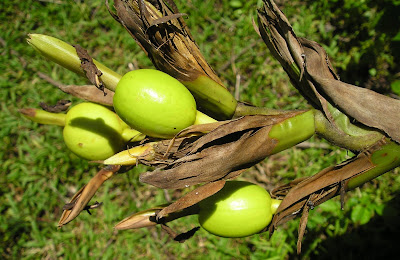
Ron also mentioned another ginger relative, locally known as kayaskason, which also has edible berries, growing at the top of a long stem, so I asked him to get some of those as well, plus anything else he could find. He came up trumps. Kayaskason turns out to be a species of Alpinia, or even a natural hybrid, and extremely rare. It seems strange that it is common enough here for the local people to give it a name.kayaskason alpinia ginger Siargao Island, Philippines

Well, that's exciting enough, but this photo shows only the unripe seed pods. We've planted it in the garden, but I don't think I can wait for the flowers to come out, so I guess we'll have to go and get some, to finally find out what it is.
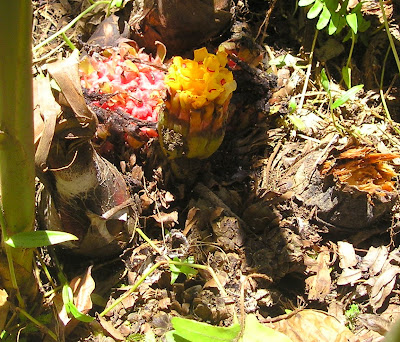
'Yellow panoon Etlingeria Siargao Island PhilippinesBut the third wild ginger that Ron brought back turns out to be a little honey. You can see in this photo the yellow flowers and pink fruit. Here's another photo of the pink fruit.Yellow panoon Etlingeria Siargao Island Philippines


This one, apparently, is an Etlingera fimbriobracteata.

Now that I know these marvels are to be found in the forests around here, I'll be looking out for them.

Saturday, 9 August 2008

Pool Swimmer

People keep on writing to me about why I've lived in the Philippines for all of 12 years and still like it.

Look at the photo above - 'nuff said.

Wednesday, 6 August 2008

Nukos Tinola

This delicious Filipino soup is the kind of thing that Shedney used to make for me when she was trying to impress me.

I won't bother to give an ingredients list, because it doesn't matter very much. This is a dish made at the moment from whatever you have available.

Take the usual onions, garlic, ginger, and so on, plus any spices you particularly like, give them a quick fry, and then throw in some fresh squid (nukos) , and whatever bits of vegetables you have around (this lot included mange-tout (snowpeas - a recently introduced vegetable, but nice, all the same), local cucumber, tomatoes, and some unidentifiable green leaves, probably kangkong (swamp lettuce) - the oval white things are cucumber seeds from the local cucumber; sikwa).

Don't cook it too much. You want the squid tasty and tender, not like bits of boiled rubber.

Then add water. Easy, isn't it? And delicious.


Monday, 4 August 2008

Lato Seaweed Salad

I do love this stuff.

Koi-Koi, my neighbour, brings me some from time to time, often together with some tajum, sea urchin roe, and they go well together.

They taste like salty little grapes, bursting in the mouth in the same way as caviare, but they're aLato seaweed salad from Siargao Island, NE Mindanao, Philippines, home of Cloud 9 surfing spot lot cheaper.

This kind is my favourite. The branches are like little green Walt Disney toadstools.

To eat them, all you do is collect them straight from the sea. If you haven't got fresh sea water to rinse them in, use a little vinegar. But make sure you do wash them; a lot of tiny crabs and shrimp live in the bunches, and you don't want to chomp those as well.

I also featured another kind of lato at: Seaweeds as Food

Saturday, 2 August 2008

Pako Fern - Lunchtime Salad

Pako fern from Siargao Island, NE Mindanao, Philippines, home of Cloud 9 surfing spotThis is pako fern; it grows naturally in the forests around here, and is gathered by women for sale in the local markets.

It doesn't rank very high on local food-value scales.

But it tastes wonderful, as a fresh salad, with the usual oil and vinegar dressing. It's crispy and tasty.

Here, it's thought of as an occasional delicacy, but otherwise as a famine food, the only thing you can find to eat after a typhoon or earthquake.

Last year, when exceptional rains, floods and landslides cut Lanuza (opposite my island on the 'mainland' of Mindanao) off from the outside world, this was all they had left to eat.

If the local people could somehow find a way to get this salad into Western supermarkets, they'd have a winner.
It's very cultivable.

Incidentally, when I talk about the 'usual oil and vinegar dressing', I'm not referring to all those fancy Mediterranean virgin olive oils and balsamic vinegars, that cost a fortune. I'm referring to our very own cold-pressed virgin coconut oil, and the vinegar that results from not drinking all the coconut sap tuba wine in time.

No sooner had I first written the draft of this, than I wanted to find more about this wonderful salad. Here is a photo of pako fern being served in a Vancouver restaurant, from vacationtime at Flickr. It looks as if these are the very top fiddlehead buds, braised lightly.

This is not so good; it's like the French, who braise lettuce, for god's sake. The Frogs don't know nuffink about cooking.


Here is the fern, growing wild, locally.

And, finally, here's a recipe for Kerabu pucuk pakis from a feast, everyday, who seem to come from Malaya, and are obviously interested in food, because they call themselves thedroolteam.

Pakis kerabu
2 cups pakis soft tips, washed and cut into 2" length
1 tablespoon dried prawns, washed and soaked

Dressing
1 tablespoon fish sauce
2 tablespoon lime juice
1-2 bird's eye chillies, chopped
sugar, to taste

Blanch the pakis in boiling water for 2-3 minutes; rinse in cold water and drain.
Drain the dried prawns and chop or pound coarsely; fry in a dry pan without oil over medium heat until fragrant and golden.
Sprinkle a pinch of sugar on the dried prawn to caramelise and off the heat.
Mix together the dressing, adjust to suit your taste (our palates lean heavily to the sourish side); toss in well with the pakis and chill. Mix in the dried prawns to serve.

Malay foods seem to be a lot more subtle and interesting, than Filipino foods, and that puzzles me. Perhaps the Malays have a longer and more 'civilised' culture history than my neighbours on this small island?

Tuesday, 13 May 2008

Siargao Pythons

Python skull, Siargao, PhilippinesI am running out of things to say about my life; it's a wee bit humdrum, so:

About two years ago, I started a temporary zoo of local animals and featured some of the photos I took in my website section on Early Human Diet.

That shows the obvious fact that along shorelines from East Africa to right out to here, the mammals and reptiles are very much the same.

See mammals here and this particular species of reptile here.

My first python died, before I could even get him home.

He'd been attacked by a bunch of local timber-stealers, and was moribund when we found him. He died, and decayed, on the 4 hour trip home, and we couldn't even recover his beautiful skin, that had been hacked around by the timber-stealers' machetes.

But we did render down his skull:

As you can see, he had vicious, back hooked, and very sharp teeth.

It was a bit too much trouble to reconstruct the bones. If we had, we would have demonstrated the very flexibleskull structure of the snake, with the bones joined by cartilage and sinew, and not rigidly fused together.

This allows the snake to stretch its jaws to the maximum when trying to swallow anything large. The back-hooked teeth ensure that anything it is trying to swallow has great difficulty in getting out again.

Pythons are not poisonous, but are not very friendly either. If you get a body part into a python's jaws, it's very difficult to get it out again.

Besides which, their 'wrapping muscles' are really, very very strong.

My second python was brought to me from Consuelo, just up the way, where it was caught trying to cross the (only) road.

He's the fellow shown top right. Only about 3 feet long, but he definitely didn't have a 'good' character.

I f***ed up the photo just following that, because he suddenly attacked, and I panicked. (I'd already been through the problem of taking him out of his chicken-coop, and having him wrap around my lower arm while he proceeded to bite my thumb).

After that insult to my hospitality (I had local kids bringing rats and mice for his dinner) I took him back to another jungle village and let him go.

Wednesday, 17 October 2007

Voyage To the Big City - Coin Divers

I haven't been to Cebu City since my last court hearings in July, and that wasn't much fun, although I had great pleasure in accepting the resignation of my lawyer; he was totally useless.

I decided to go at the penultimate hour; I had to go to Surigao City for some itsy-bitsies, and I hate the place so much that at 5pm I decided to take the 7pm boat to Cebu to get out of there.

The trip is overnight; it gets into Cebu about dawn, plus or minus a bit. So we don't get to see very much of the intervening trip. It follows Magellan's route to Cebu, from Limasawa Island on, and about dawn we pass Punta Enggaño (Enchanted Point) on Mactan Island.

Punta Enggaño is the prime shell-collector's source; everyone in the village is involved in the shell business somehow. Some specialise in rare shells, others in regular, pretty stuff for tourists and bathroom decorations, and others make some of the best fakes I've ever been taken in by. (If you've ever greedily bought a very rare shell at a bargain price, you can imagine your chagrin when you look at it again next day in daylight, and see that a tuppenny shell has been 'adjusted' with a hand file and some spray paint into a very great rarity. So you swallow your great pride in your infallible 'expertise', and endeavour to find the next sucker in line.)

You pass through the strait between Cebu City and Mactan Island a bit after dawn, and pass through the channel to Pier 1, in the heart of the city. With a bit of manoeuvring (hurling of anchor lines, etc) we end up with the bow pointing towards the dockside. But not before we've been visited by the local coin divers. They come out after every incoming ship, hoping for a few pesos.

The wife holds the coin collecting net, and the husband nonchalantly paddles, using only one hand and his ankle, to twist-paddle the boat along. If his wife misses the thrown coins, he dives in and gets them.

They have a classical bangka; long slim hull, two outriggers, and no motor, and he drives it like an extension of his own body, with consummate skill, just as you might ride a familiar bicycle.

A few days later, arriving in Surigao City, we are met by the local coin-divers, but they've gone all hi-tech. Their boats are rice sacks, stuffed with polyethylene foam chunks from broken fish-boxes, and each one wears a single or two ping-pong bat shaped paddles strapped to his feet.

But the little buggers still catch every coin I toss over the side, no matter how I try to obstruct them, by throwing coins out of reach.

Wednesday, 19 September 2007

Oh! What a Lovely Neighbour!

Andreas Mikoleiwicz Patrick's on the Beach Siargao Island Philippines Would you rent a used seaside cottage from this man?

He is my friendly and cooperative neighbour., the owner of Patrick's-On-The-Beach, which surrounds me on three sides.

We haven't spoken to each other in over two years, ever since I went round to introduce myself, and he told me that he was just about to take over the quiet garden of the house I had just rented from Dado, demolish my thatched barn that I was about to use as a bead-craft sweatshop, and leave me with just the mere concrete shell of a house that goes with those two invaluable assets.

Next day, I used the back gate from my garden, for a swim. It leads about 10 metres through the cottages that Andreas rents from my landlord, Dado, to the sea. I was confronted by this fellow, who told me he was concerned about security for his 'resort' - Patrick's On The Beach, and unless I kept the gate padlocked, he would padlock it himself.
If he did, I said, I would effing cut off the effing padlock.
Next day, he marched up my garden to my bead works, where the girls were working away industriously, accompanied by the town's Chief of Police, and accused me of 'threatening' him.
Nothing came of that, of course; it was typical bluster.
But that summer, while I was away in Spain flogging beads to punters in the local markets, he reinforced the closure by boarding up 'his' side of the gate.

More on the lovely Andreas in later posts, including the intriguing tale of the source of the above smug self-portrait.

By the way, if you feel like you would like to donate to his orphanage scam, send a blank cheque to:

Messenger Of Joy Foundation
14721 S. Biscayne River Drive
Miami, FL 33168
Tel (305) 687-4107
Fax (305) 769-9924
andreas@mojf.org

Expensive Birds

I always knew there was one small tiny problem involved with keeping a pretty woman; decoration, maintenance and upkeep costs.
The town Fiesta is due on Friday, so there is a travelling fair of ukay-ukay stalls set up on the foreshore next to my neighbouring village of squatting fishermen, Mabua, between me and the creek. Ukay-ukay is basically second-hand clothes (yes - you know the ones you dutifully collect for the poor of the world? Well, they get bought up on arrival by Chinese traders, and farmed out to the local equivalent of Gypsies, who travel from town to town at fiesta time. They sell sheeting by the kilo, T shirts for 50p ($1),shorts for 100p, and so on.
On Monday night, I took Shedney out for our usual pub-crawl from Lalay's at the end of the Boulevard, to Nine Bar just up the road from me.
Only then did I notice that the short-short-shorts she was wearing had a broken zip, so when the tails of her shirt opened, everyone could see her her sweet little cotton-clad pussy.
So I blew up; just quietly exploded, thrust a 500p ($5) note into her hand and growled that she'd better get to the bulanon (ukay-ukay market) first thing in the morning, and get herself some new (and longer) shorts.

Shedney in new outfit Siargao IslandSo what did the little minx do? She went straight up to Larry's Reef Break Shop (good website), where he has an enticing show of beachwear, and bought herself a grand new ensemble, plus a T-shirt and pair of short-short-shorts. The short-short-shorts have a hand-embroidered motto: "I AM A SIARGAO ISLAND SURF BITCH", and she blew the whole goddam' $5!

But she does look good in it, I must say.

And so thought Harry the Canadian Real Estate Millionaire, as he gazed, tongue lolling out, at that little area just below her collar bone.

Wednesday, 22 August 2007

Starting Out

This weblog will be an irregular notebook about my life (and occasional thoughts) on a small Pacific island, at the far right hand side of the Philippines. You can see what the place looks like at my website:
http://www.coconutstudio.com/GENERALLUNAfinX.htm

I change my obsessions with the seasons, and my current one is number systems in the Austronesian languages, of all things. I've been working on it for about four months now.

I thought, originally, that my findings would upset the entire current paradigm about the history of the people around me (the Austronesians), who managed to settle all the South East Asian islands, including the Philippines (where I live), Indonesia, and then went on to Easter Island, Hawaii, New Zealand, and west to Madagascar, just off the coast of East Africa.

Of course, I was wrong, but not all that wrong.

The Austronesian migrations were the widest spread of a distinctive human culture and anguage before the European expansions following the Age of Exploration in the 16th and 17th centuries.

The people who undertook this quite amazing migration share that culture and language with my island neighbours. Some of that culture is good; some very good, and some bad. (For a bit of the bad, see: http://www.coconutstudio.com/fishing%20expedition.htm).

I'll be writing a little about bits of that culture and language from time to time in this weblog. It will include random jottings that don't merit a full web page.