Showing posts with label environment. Show all posts

Thursday, 7 October 2010

Chicken Ham - Sensation!


I don't know if you've ever eaten petto d'oca, smoked goose breast; it is seriously delicious and good, and puts mere pork ham in the shade. I used to make a trip to a special shop to buy it every time I visited Italy.

So I decided to try a different version; smoked chicken. I bought a plump one, de-boned and quartered it, (see http://www.youtube.com/watch?v=YzmjtTUQS6g & http://www.youtube.com/watch?v=QFjFtMA-TJE&feature=related) then soaked it in a strong brine for 4 hours.

Tuesday, 26 August 2008

Tsunami Notice

Tsunami notice from Siargao Island, NE Mindanao, Philippines, home of Cloud 9 surfing spotStrange thing, you know; since the Big Tsunami in the Indian Ocean on December 27 2006 (my birthday, as it happened) everyone has got all concerned.

It's fairly obvious that, on an island like Siargao, where most of the flat ground is only 1 or 2 metres above high-tide mark, that, if a tsunami happened, we'd all be done for.

A tsunami's not something you can plan ahead for.

We're only a few miles from the Philippine Deep (some 10km down), and if, say, a huge submarine landslide or something similar happened there, we wouldn't have much time to run.

Tsunami notice 2 from Siargao Island, NE Mindanao, Philippines, home of Cloud 9 surfing spotSo there's not much point in putting up notices like this, especially when it's distinctly ambiguous about whether you have to run 14 kilometres or just a mile.

So, it may happen at any time, and since I can't run much any more, I'll just plod along, and pray (even though I'm an atheist).

Friday, 22 August 2008

Siargao Zingiber Project 2 - Etlingera fimbriobracteata

iuEtlingera fimbriobracteata from Siargao Island, NE Mindanao, Philippines, home of Cloud 9 surfing spotRon was the first to find one of these local ginger plants, and I wrote about them here.

I didn't realise at that time quite what a very strange plant this is.

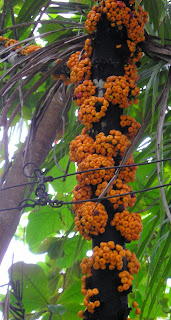
If you look closely, you'll see a nascent bud to the left, a bud with about six yellow and red flowers open in the middle, and, to the right, what is presumably the next stage, a sort of mini-pineapple with the petals withered, and pink fruit developing.Etlingera fruit body split from Siargao Island, NE Mindanao, Philippines, home of Cloud 9 surfing spot
etlingera ginger fruit from Siargao Island, NE Mindanao, Philippines, home of Cloud 9 surfing spotNow, we haven't been watching these plants closely enough. (I've transplanted a few to my garden, where we can keep a eye on them).

Suddenly, at the next stage, they produce fruit, about 3 metres up, on long stems.

What's going on? How, exactly, does that mini-pineapple transform itself into a ten-foot fruit-bearer?

The only answer is to camp out next to one of the mini-pineapples, and photograph it, every hour, through the night.

Ron - get your sleeping-mat ready!


Update: 24/8/08. I was completely wrong on all of this. The small pineapple does NOT suddenly transform into fruit 10 feet above it, Instead, it's a different, but related plant that happened to grow in the same place, called Alpinia haenki (or macassarensis), which is even more rare.

Wednesday, 20 August 2008

Coconut Harvest

coconut harvest from Siargao Island, NE Mindanao, Philippines, home of Cloud 9 surfing spotThis is the usual three-monthly coconut harvest from the sixteen trees in my garden. The usual haul is 5 sacks, each of about 25 kilos kopras meat (about 100 pieces per sack).

It's a wonderful, bountiful tree - see: Coco Loco

climbing coconut tree in Siargao Island, NE Mindanao, Philippines, home of Cloud 9 surfing spotIt does everything you can think of, except, possibly, marriage guidance, but it's almost certainly got a secret chemical that will help with that kind of problem.

One brave fellow climbs the trees and trims off the ripe coconuts, and they come crashing down like small bombs.Lugit man shelling coconuts  Siargao Island, NE Mindanao, Philippines
Then they chop the whole nuts in half, and scoop out the meat with a specially-shaped knife, a lugit.
tapahan copra drying house from Siargao Island, NE Mindanao, Philippines, home of Cloud 9 surfing spot


The meat is now kopras, but it has to be dried first, in a tapahan, which is really a bodged-up smokehouse, like this. The smouldering coconut husks are used for fuel, and the process takes most of a day.

I've often wondered why the operators of the tapahan don't also use the process to cold smoke a few fish or sides of pork, but perhaps they've never thought of it

Monday, 18 August 2008

Fidelity - Female Fruit Flies Only Fuck on the First Date

fruti flies matingI'm not a lot interested in fruit flies, as such, but they (Drosophila) have been a great deal helpful to science in general and especially in the genetics corner.

It seems that female fruit flies are fussy. After the first time they have intercourse, they don't want to do it again.

Someone has discovered (or thinks he has) how.

Now this is how you find out the the details of the complicated and devious mind of the female fruit fly.

You feed them. With yeast that contains lots of heavy nitrogen. That isotope labels all of the female proteins.

Then you look at them after they've fucked. Anything that didn't have the heavy nitrogen was given by males. The researchers discovered some sixty-three proteins from fruit fly semen, which may suggest that the male fruit fly lacks confidence in his wife's fidelity, and is over-doing it a bit.

(Sorry to anyone who's offended by the fffour-letter word - the alliteration was just too good to resist).

Sunday, 17 August 2008

Curacha Dancing Crabs

Curacha dancing crabs are a speciality of Zamboanga, at the extreme right hand bottom of the Philippines.

The first time I ate them, there, I found myself sitting at the next table to Nur Misuari, the politician then in charge of the Muslim provinces (ARMM) of Mindanao, and they were delicious (no, not the politician and his cronies, but the crabs).

Since then, of course, Muslims have gone very much out of fashion.

Nur Misuari's done a bit of jail time since, but then so should anyone who sets out to be a politician; a little bit of waterboarding wouldn't go amiss.

But we also have curachas here, in Siargao, where they are known as kanduyon or ladan.

They are good to eat, because almost all the useful stuff is in the main shell, so you don't need to fuss about too much.

They're called dancing crabs, because they sit upright in the water, on their back legs, and ponce about, like a bunch of poofs at a party.

Notice their claws; they're not a lot of use, being angled in the wrong way, quite against heavy usage. they merely use them for posing.

If these things were created, then the Great Creator made more than a few design mistakes. Thank God, He won't be held accountable.

But Thank God, He made them tasty. You can find some better photos than mine here.

Saturday, 16 August 2008

Siargao Zingiber Project - Sidelining

For the first time, I got up off my bum, and went myself with my crew (Ron & Shedney), to find some new and exotic ginger plants reasonably nearby.
We went to Victor's Flying Fox Bar, built, like only a total crazy could do, out in the boonies, opposite a perfect jungle mountain, where the flying foxes do a grand fly-past every evening, dead on time at 2.5 minutes past dusk.

We walked along the edge of the mountain, and we did find a couple of new ginger plants (which I'm waiting to have identified).
But, more than that, we found some other strange plants that I don't have much of a clue about:

This is wild ubi, a purple yam, that, domesticated, is a great favourite here in the Philippines. It's even a top flavour for ice cream. Purple ice cream? It's delicious. Only in the Philippines.

puso banana buds siargao island philippinesAnd we found these, abandoned: Puso banana buds, but only the stripped skins, the buds taken off to make into a fabulous salad.

And then this one, known locally as padjaw. It's an aroid, but I don't know much more about it, and I don't know why it grows 'pretend peppers'.
padjaw aroid plant Siargao Island Philippines

Siargao Zingiber Project - 1

Following on from my Pano'on 1 and Pano'on 2 posts, I've got all enthused about ginger plants.

It seems, according to John Mood, a 20-year expert on ginger (Zingiber) plant taxonomy, that we may just have a new species on our hands.

Here, it's called kayaskason, and it's very common. John asked me to preserve the leaves and inflorescence (a la herbarium, pressed between newspaper sheets). This is a bit difficult, because we don't get newspapers hereabouts, and the big fruits don't really press very well.
However, I'll do my best.

I proposed, very strongly, based on the first specimens that Ron brought to me, that the damned plant didn't have flowers.

But it does.

Here's a picture of one, a bud popped into a vase of water at 5pm and open and greedy at 7pm.

I'm not a botanist, so I really didn't know that my photo was upside down.

It looked extraordinarily like the face of one of the local horseshoe bats. Even down to the two very small 'eyes' either side of its 'nose'.

Now, if I was a bat, I'd visit this flower, and land on the strong stem just behind it. Then I'd bend over, and find I was facing the thing upside down. I would be doing 69 face to face with a friend from another biological kingdom.

Probably, I'd lap up all the ants crawling around the nectar, and then lap up some of the delectable stuff for myself.

Sunday, 10 August 2008

Pano'on - Local Candy - Bromeliad or What? - Part II

I first wrote about pano'on just a week ago, and things have developed rapidly. First I contacted Brandon McHenry, who identified my Dischidia or talikubo for me. He, in turn, suggested that pano'on was not a bromeliad at all, nor a relative of maize, but a relative of ginger, which was a total surprise to me.Pano'on Hornstedtia conoidea Siargao Island, Philippines

Brandon also introduced me to John Mood, a world authority on ginger taxonomy, who confirmed the plant was probably Hornstedtia conoidea, which also grows in Borneo.

Well, I hadn't seen much more of the plant than a few ripening buds and a few leaves, which had made me think it was this: Zingiber mioga - Japanese Wild Ginger, which is commercially-grown in Japan (and now in New Zealand) for its young buds, which are a great delicacy.
Zingiber mioga - Tsukuba Botanical Garden

The buds are shown here:
(Click photo to go to 'the scent of green bananas blog for recipes)

Well, this really got me thinking. If New Zealand farmers are canny enough to grow this stuff for export to Japan, why shouldn't we do the same here in Siargao? Looked easy to me; it's a perennial, so you plonk it in the ground, and pick a bit idly from time to time.

But if you look at the botanical drawing, you'll see that mioga has a white flower, whereas our pano'on's flowers turn out to have a brilliant deep red flower (top right). And the local people don't eat the buds, although they do eat the unripe berry pods (and so do rats and other forest rodents - we didn't find a single young bud on the specimens Ron brought back, from his second expedition on Thursday).

Ron also mentioned another ginger relative, locally known as kayaskason, which also has edible berries, growing at the top of a long stem, so I asked him to get some of those as well, plus anything else he could find. He came up trumps. Kayaskason turns out to be a species of Alpinia, or even a natural hybrid, and extremely rare. It seems strange that it is common enough here for the local people to give it a name.kayaskason alpinia ginger Siargao Island, Philippines

Well, that's exciting enough, but this photo shows only the unripe seed pods. We've planted it in the garden, but I don't think I can wait for the flowers to come out, so I guess we'll have to go and get some, to finally find out what it is.

'Yellow panoon Etlingeria Siargao Island PhilippinesBut the third wild ginger that Ron brought back turns out to be a little honey. You can see in this photo the yellow flowers and pink fruit. Here's another photo of the pink fruit.Yellow panoon Etlingeria Siargao Island Philippines


This one, apparently, is an Etlingera fimbriobracteata.

Now that I know these marvels are to be found in the forests around here, I'll be looking out for them.

Saturday, 9 August 2008

Pool Swimmer

People keep on writing to me about why I've lived in the Philippines for all of 12 years and still like it.

Look at the photo above - 'nuff said.

Friday, 8 August 2008

Marang Fruit

Marang - Artocarpus odoratissimus

This fruit is about halfway between jackfruit and breadfruit, and a member of the same family. It grows on large trees (larger usually than jackfruit) and smells wonderful. That, of course is why someone called it 'odoratissimus'.

The skin is made of countless tiny tubules or spines, and you simply cut through it and twist it off, to reveal the individual fruit (actually arils, about the size of a grape). Each one of these has a large seed inside (which you can also eat, after boiling or roasting).

There's not a lot of taste to a marang, but it does smell good.

These are some I photographed in the Surigao City fruit market, going nicely yellow as they ripen.

Actually, there's a superb photograph at MVI~'s photostream at Flickr, which I can't compete with.
You'll also find more information at the ever-indispensable Wikipedia.

Shedney loves them; I am ordered, indeed commanded, to bring some whenever I do a bank run to Surigao City.

(There don't seem to be many exotic local fruit available here on Siargao Island. If people have a tree like this in their garden, it tends to go to the family, and no-one else).

Tuesday, 5 August 2008

Gecko Corner

Gecko Corner, just above the righthand side of my Siargao Island 'home office'This is Gecko Corner, just above the righthand side of my Siargao Island 'home office' at about 7 pm. All of the extended family are out there, and they're patrolling the best bits for tasty insect nibbles.

Actually, there are half a dozen more, to the left side, but they all maintain very careful territories. Sometimes, there's a little bit of a flurry, with a gecko growl and a scuffle; they are quarrelling about sex or territory rights, both of which seem to be prevalent problems amongst most animal groups.

Geckos have evolved amazing abilities for holding onto vertical and even sub-horizontal surfaces. They can stick to anything...sometimes. See: Gecko's amazing sticky feet

Gecko through glassand when that doesn't work, they can turn around, mid-air, to make sure they land properly:

See:
Tail 'key' for gecko acrobatics

They are all around my house; and are fairly ambitious.

gecko on computer
Sometimes they fall off the ceiling.

When they land, stunned for a moment, you can see the thought, in their eyes 'Where the f*** am I now?'

This one plopped onto my computer keyboard.

Other stuff drops into my evening drink occasionally.

Some mornings I find some poor soused gecko in the glass I left on the table.

Gecko eating moth
This little fellow is trying to eat a moth more than half his body size (excluding head and tail).

He can't bite the insect in half; he'll just have to do the best he can to swallow it whole.

Geckos mating

Very occasionally, the geckos stop fighting each other, and have some fun.

I'm going to be very careful about this, because Google might put me on the pornography blacklist if I publish this photo.


But look at their eyes; neither look exactly ecstatic; much like humans, really.

My apologies for the f***ed up layout of this post (and others). Google's Blogger has been giving me much angst today.

Monday, 4 August 2008

Lato Seaweed Salad

I do love this stuff.

Koi-Koi, my neighbour, brings me some from time to time, often together with some tajum, sea urchin roe, and they go well together.

They taste like salty little grapes, bursting in the mouth in the same way as caviare, but they're aLato seaweed salad from Siargao Island, NE Mindanao, Philippines, home of Cloud 9 surfing spot lot cheaper.

This kind is my favourite. The branches are like little green Walt Disney toadstools.

To eat them, all you do is collect them straight from the sea. If you haven't got fresh sea water to rinse them in, use a little vinegar. But make sure you do wash them; a lot of tiny crabs and shrimp live in the bunches, and you don't want to chomp those as well.

I also featured another kind of lato at: Seaweeds as Food

Saturday, 2 August 2008

Pako Fern - Lunchtime Salad

Pako fern from Siargao Island, NE Mindanao, Philippines, home of Cloud 9 surfing spotThis is pako fern; it grows naturally in the forests around here, and is gathered by women for sale in the local markets.

It doesn't rank very high on local food-value scales.

But it tastes wonderful, as a fresh salad, with the usual oil and vinegar dressing. It's crispy and tasty.

Here, it's thought of as an occasional delicacy, but otherwise as a famine food, the only thing you can find to eat after a typhoon or earthquake.

Last year, when exceptional rains, floods and landslides cut Lanuza (opposite my island on the 'mainland' of Mindanao) off from the outside world, this was all they had left to eat.

If the local people could somehow find a way to get this salad into Western supermarkets, they'd have a winner.
It's very cultivable.

Incidentally, when I talk about the 'usual oil and vinegar dressing', I'm not referring to all those fancy Mediterranean virgin olive oils and balsamic vinegars, that cost a fortune. I'm referring to our very own cold-pressed virgin coconut oil, and the vinegar that results from not drinking all the coconut sap tuba wine in time.

No sooner had I first written the draft of this, than I wanted to find more about this wonderful salad. Here is a photo of pako fern being served in a Vancouver restaurant, from vacationtime at Flickr. It looks as if these are the very top fiddlehead buds, braised lightly.

This is not so good; it's like the French, who braise lettuce, for god's sake. The Frogs don't know nuffink about cooking.


Here is the fern, growing wild, locally.

And, finally, here's a recipe for Kerabu pucuk pakis from a feast, everyday, who seem to come from Malaya, and are obviously interested in food, because they call themselves thedroolteam.

Pakis kerabu
2 cups pakis soft tips, washed and cut into 2" length
1 tablespoon dried prawns, washed and soaked

Dressing
1 tablespoon fish sauce
2 tablespoon lime juice
1-2 bird's eye chillies, chopped
sugar, to taste

Blanch the pakis in boiling water for 2-3 minutes; rinse in cold water and drain.
Drain the dried prawns and chop or pound coarsely; fry in a dry pan without oil over medium heat until fragrant and golden.
Sprinkle a pinch of sugar on the dried prawn to caramelise and off the heat.
Mix together the dressing, adjust to suit your taste (our palates lean heavily to the sourish side); toss in well with the pakis and chill. Mix in the dried prawns to serve.

Malay foods seem to be a lot more subtle and interesting, than Filipino foods, and that puzzles me. Perhaps the Malays have a longer and more 'civilised' culture history than my neighbours on this small island?

Friday, 25 July 2008

Strange Fig Tree

Strange fig tree PhilippinesThis is a strange fig tree that grows in my garden. The fruit grow directly on the trunk of the tree, in bunches, quite unlike other figs, and the fruit come along every three or four months.

Sometimes birds do try and eat them, but there is not enough surface for them to perch and peck. So I left the coconut frond that fell down to give them some purchase. On a closer look, I found that the yellow figs are unripe. They go dark red as they ripen, and the birds certainly go for those.

I'm interested to see if this fig has a life style dependent on insects, as so many figs do.

Tomorrow (or maybe the next day, life being a little bit lazy) I'll get one of the figs and dissect it.

If there is a story at all, I'll post it here.

Strange Fig Philippines
[Day 2 Well, it's now tomorrow, and here is a picture of the fruit. The yellow one is unripe, and the red one was very ripe and sticky. I couldn't see any insects in either (some figs have friendly relations with tiny wasps).

Anyway, I ate it, and I'm not dead yet.

By the way, the two wires crossing the photo above are my electricity supply; great bit of junction wiring to the left.

[Day 3] I've now realised that the rest of the world gets up in the morning a lot earlier than I do, so this morning I got up and watched that bloody fig tree.

They're all there, from the sunbirds, to that-bright-yellow-bird-I-don't-the name-of, to the imported European sparrows (who chat with a Spanish, not a Cockney accent).

Wonderful sight, even through the haze of a normal morning hangover.

DH Lawrence wrote this about figs:

The proper way to eat a fig, in society,
Is to split it in four, holding it by the stump,
And open it, so that it is a glittering, rosy, moist,
honied, heavy-petalled four-petalled flower.
Then you throw away the skin
Which is just like a four-sepalled calyx,
After you have taken off the blossom with your lips.
But the vulgar way
Is just to put your mouth to the crack, and take out the flesh in one bite.
Every fruit has its secret.
The fig is a very secretive fruit
.

As you see it standing growing, you feel at once it is symbolic:
And it seems male.
But when you come to know it better, you agree with the Romans, it is female.
The Italians vulgarly say, it stands for the female part; the fig-fruit:
The fissure, the yoni,
The wonderful moist conductivity towards the centre.
Involved,
Inturned,
The flowering all inward and womb-fibrilled;
And but one orifice.
The fig, the horse-shoe, the squash-blossom.
Symbols.
There was a flower that flowered inward, womb-ward;
Now there is a fruit like a ripe womb.
It was always a secret.
That's how it should be, the female should always be secret.
There never was any standing aloft and unfolded on a bough
Like other flowers, in a revelation of petals;
Silver-pink peach, venetian green glass of medlars and sorb-apples,
Shallow wine-cups on short, bulging stems
Openly pledging heaven:
Here's to the thorn in flower! Here is to Utterance!
The brave, adventurous rosaceรฆ

I'm sorry, I can't go on with this. It's the plea of a Northern Englishman to a fruit he probably only tasted once in his life. It's nice stuff, but isn't he over-doing it a bit?
Rest of it at http://www.kalliope.org/digt.pl?longdid=lawrence2001061702

Wednesday, 23 July 2008

Don't Go Down to the Swamps Today...

...because the Nipa Palm flower may get you.

The nipa flower's the nearest thing to a space monster that I've ever seen. They look as if they're about to come bursting and bubbling out like distinctly unfriendly extra-terrestrials. Just like Day of the Triffids. And they're big.

The flower usually grows more than a metre high, and in the fetid darkness of the brackish swamps that nipa palms inhabit, they stand out like, well, aliens.

Later, a seed head will grow, with about 40 large seeds, each enclosed in a strong husk, the whole about the size of a basketball. The seeds themselves are often called 'vegetable ivory' and are reputed to be carved by native tribesmen somewhere or other.

I tried carving them myself, but they didn't live up to their advance billing.

The nipa palm (Nypa frutescens) itself is quite innocuous, as are the flowers, of course.

The leaves are used as roofing material , widely available as roughly 4ft x 15" 'tiles', at about 8รง each. They don't last a lifetime, but they are waterproof, and a lot cooler than the corrugated iron sheets that are nowadays replacing them.

They don't need to be 'farmed' as such, but nipa stands do have owners, so be careful to ask if you want a nipa seed head as a souvenir.

The flowers, when they have grown seed heads, are tapped, like coconut flowers, for their sweet sap, which is then distilled to make pa-oroi, a strong-tasting liquor which, thankfully, is very cheap. (It's the local hooch that I mention in my blog title; I usually buy it by the 5-gallon jerry can).

I keep my hooch in a plastic water dispenser with a tap. It is half-filled with coconut-shell charcoal, that filters out the fairly awful natural taste of the pa-oroi.

My original intention was to make fruit-flavoured liquors of the stuff, by macerating some of the local fruits in it, but each time I tried that, I took to tasting it frequently, and none of my efforts ever matured, as they should have done, for more than a month.

Cheers!

PS 1 I just found I did this same story about a year ago at: http://smallislandnotes.blogspot.com/2007/10/pa-oroi.html Shows how forgetful pa-oroi makes you.

PS 2 A wonderful photo-essay on the making of pa oroi, or laksoy, as the Butuanons call it (about 3 hours drive from Surigao City is at EatingAsia:
http://eatingasia.typepad.com/eatingasia/2008/04/sago-isnt-the-o.html

Monday, 21 July 2008

Jungle Terror Orchid

Jungle terror orchid This is part of an orchid that grows on the second coconut tree down in my garden. It's the sexy bit, the bit that makes insects (mostly bees) come in to pick up pollen.

I've not seen such a greedy image in nature before. It has little beady eyes, and a gaping mouth, and even little hands at each side. And it's got a big wide-open bag to hold all the victims it finds, for future consumption.

It even appears to have arms and hands, to drag its victims into its ever-open pouch.

But don't those insects ever watch movies?

The creature at the heart of this flower is a copy (or perhaps the inspiration?) for the creature that burst into the world in Alien.

H.R.Giger's wonderful inspirations for the original film were great, but the first Alien was aggressive.:Sigourney Weaver Alien 2

The second film, though, showed a more seductive Alien, and Sigourney Weaver fell for it.

Wednesday, 16 July 2008

Barringtonia - Bito'On - Sea Poison Tree

I'm getting into this digital painting lark now, and I'm thoroughly enjoying it.

This is a crudely altered photo of a Barringtonia or bito'on tree flower.

The tree grows near the shore almost everywhere in the coastal areas of Island SE Asia and Oceania.

It's a wonderful shade tree, and when it's in the mood, produces these fabulous flowers, about three inches across, with a fan of stamens (pistils?) at dusk.

The next morning, they are moribund and abandoned on the ground, as this one was.

A lovely specimen of the tree used to grow in the churchyard in General Luna, but the holy Catholic vandals of that institution cleared it of this and several other beautiful trees.

But Barringtonia doesn't only produce flowers. The fruit look a bit like squared-off apples, and they're valuable. They float very well, so they're widely used as net-floats (and also as the way for Barringtonia to colonise new shorelines).

The area of their distribution is very, very near that of Austronesian languages, and of the natural distribution of coconuts.

And the flesh of the fruit is poisonous to fish. Don't fiddle about with big, bright yellow lures, just zap 'em.

See more about Barringtonia here : (Apologies if you don't go straight to the bookmark; I haven't updated this page for ages).

Them green lizards

Emerald Green Skink - Lamproletis smaragdinus eating geckoWe have a couple of 'daily lizards' around the place.

There are the always-present geckos. As I sit at my worktable in the evening, I can count around a dozen on the walls and ceiling around me.

They chatter, attack and rape each other, and are altogether a very useful digression from the problems of thinking and writing.

But we also have another lizard. The Emerald Green Skink - Lamproletis smaragdinus.

I featured them here. They are very beautiful; one of those things that you see occasionally, that give you immediate pleasure, just from their appearance - a bit like a bunch of silent hot air balloons crossing the escarpment in front of you, as they used to do, over the Chiltern Hills, when I lived in Tring, Hertfordshire. It's only when they pass directly overhead, and fart, as they boost the hot air, that you realise they are not disembodied spirits, but have bodily functions as well.

So when I saw one of my Emerald Lizards chomping a gecko, I was a little disappointed that he had very definite bodily functions, as well.

Friday, 11 July 2008

CO2 Pollution Will Turn the Oceans Into Soda Water

I have seen, since I've lived here in Siargao (just 10 years now) the slow deterioration of the lagoon in front of us, with slimy green algae growing where none did before, shattered and bleached coral reefs, etc.

But I didn't know about this horror to come:
CO2 Pollution Could Erase Coral Reefs (from Wired Science)

It is truly a horrible prospect:
" While most of the attention on the impacts of carbon dioxide emissions has focused on its ability to act as a greenhouse gas, that warms the earth's climate, the changes CO2 emissions will bring to the world's oceans are receiving increasing attention. The more CO2 in the atmosphere, the more of it that dissolves into surface ocean water. That small chemistry change could cause huge changes in marine biology.

Marine organisms, like coral, that build skeletons out of calcium could find themselves unable to do so. If current emissions trends continue over the next decade, the world's marine creatures will be dealing with what's essentially an alien ocean. The last time ocean conditions like those predicted for mid-century existed was long before humans walked the earth".

Not only coral, but shellfish, would be affected. Imagine walking along a beach (if there are any after sea-level rises) and finding the only things washed up were plastic waste and greeny-brown scum, and no sea shells at all.