Are the largest group of Jews on earth, those of the greatest democracy and freedom loving military enterprise the world has ever seen, the United States of America, finally beginning to realise what their connection with, and support of the state of Israel, really implies?
I am not qualified to speak on this, but Tom Karon is. He's Jewish himself, and a fully paid-up campaigner against apartheid in South Africa. His very thoughtful and entirely unpolemic essay at TomDispatch says it better than I ever could.
Sunday, 16 September 2007


Growing Dissent among American Jews
Are the largest group of Jews on earth, those of the greatest democracy and freedom loving military enterprise the world has ever seen, the United States of America, finally beginning to realise what their connection with, and support of the state of Israel, really implies?
I am not qualified to speak on this, but Tom Karon is. He's Jewish himself, and a fully paid-up campaigner against apartheid in South Africa. His very thoughtful and entirely unpolemic essay at TomDispatch says it better than I ever could.
I am not qualified to speak on this, but Tom Karon is. He's Jewish himself, and a fully paid-up campaigner against apartheid in South Africa. His very thoughtful and entirely unpolemic essay at TomDispatch says it better than I ever could.
A Terrible Anniversary
Today, September 15th, is the 25th anniversary of the massacres in the South Beirut Palestinian refugee camp/squatter village of Sabra/Shatila by right-wing Phalangist (Kataëb) forces led by Elie Hobeika, aided, abetted and benignly supervised by the Israeli Defense Force, and including Israeli commandos and pro-Israeli mercenaries, led by Ariel Sharon.
The Israelis had only recently occupied West Beirut, despite promising the world that they wouldn't, after the main forces of the PLO had been packed off to Tunis, along with Yasser Arafat. You can read the whole story here.
 The camps were full of Palestinian refugee women and children, who had either been there since 1948, or were born there. The lowest estimate of deaths was 700; the highest 3,500; nobody really knew how many lived there, and nobody counted the individual bodies afterwards.
A letter (and tribute to a brave and wonderful woman, Janet Lee Stevens) by Franklin Lamb, in DesertPeace actually made me weep, despite all the horrors I still read daily of death, destruction and terror in the Levant and Iraq; you have to maintain the normal appearances and attitudes of a hard nut, especially if you are powerless to do anything to right the wrongs.
This, particularly, struck me:
"Your friend, Um Ahmad, still lives in the same house where she lost her husband, four sons and a daughter when Joseph, a thick-set militiaman carrying an assault rifle bundled everyone into one room of their hovel and opened fire. She still explains like it was yesterday, how the condoned slaughter unfolded, recalling each of her four sons by name, Nizar, Shadi, Farid and Nidal. I asked Joseph if he wanted to sit with Um Ahmad and seek forgiveness and possible redemption since he has now become a lay cleric in his Parish. He declined but sent his condolences with flowers".
Um Ahmad, 'Mother of Ahmad' lost her first son, Ahmad, in 1975, during one of several Israeli rocket attacks on Sabra, billed as reprisals for 'terrorist' incidents in Galilee.
At that time, I lived in Beirut, just by the Commodore Hotel, in Hamra. The Israeli bombers flew at terrifyingly low levels over my apartment, releasing their rockets just before they passed over, and Um Ahmad came daily to clean my house.
She quietly told me, the next day, about this, but at that time, I still believed the Zionist propaganda about 'Palestinian terrorists', and how they needed to be 'punished'.
None of the perpetrators of the massacre was ever punished. Elie Hobeika, their leader, became a Minister in the Lebanese government, but, twenty years later, in January 2002, was assassinated by a car bomb, just before he might, it was rumoured, give damning evidence in the war crimes case then being prepared in Belgium against Ariel Sharon.
Twenty-five years later, Israel still pursues a policy of proxy terrorist attacks, aerial bombing, assassinations, and collective punishment, under the shelter of the world's benign ignorance, and with the approval of many.
This is what they did to a small section of South Beirut only just last summer:

Postscript: Ariel Sharon is still alive, comatose in a respirator after nearly two years. They tell me, that in the few minutes before you die by drowning, your entire life passes before your eyes and conscience. I do hope Ariel Sharon has had enough time now to reflect on his personal crimes over the past fifty years, from Qibya to Gush Emunim to his deliberate provocation of the Second Intifada to the massacre at Jenin which is not even mentioned in Sharon's Wikipedia entry.
That last massacre has been quietly 'cleaned up', but I saw the Israeli refrigerated trucks lined up outside Jenin that night in 2002. I didn't think they were there just to take away the rubble made of the refugee camp.
Pity Ariel Sharon is still too comatose to confess the horrendous truth of his lifetime as a war criminal.
The Israelis had only recently occupied West Beirut, despite promising the world that they wouldn't, after the main forces of the PLO had been packed off to Tunis, along with Yasser Arafat. You can read the whole story here.
 The camps were full of Palestinian refugee women and children, who had either been there since 1948, or were born there. The lowest estimate of deaths was 700; the highest 3,500; nobody really knew how many lived there, and nobody counted the individual bodies afterwards.
A letter (and tribute to a brave and wonderful woman, Janet Lee Stevens) by Franklin Lamb, in DesertPeace actually made me weep, despite all the horrors I still read daily of death, destruction and terror in the Levant and Iraq; you have to maintain the normal appearances and attitudes of a hard nut, especially if you are powerless to do anything to right the wrongs.
This, particularly, struck me:
"Your friend, Um Ahmad, still lives in the same house where she lost her husband, four sons and a daughter when Joseph, a thick-set militiaman carrying an assault rifle bundled everyone into one room of their hovel and opened fire. She still explains like it was yesterday, how the condoned slaughter unfolded, recalling each of her four sons by name, Nizar, Shadi, Farid and Nidal. I asked Joseph if he wanted to sit with Um Ahmad and seek forgiveness and possible redemption since he has now become a lay cleric in his Parish. He declined but sent his condolences with flowers".
Um Ahmad, 'Mother of Ahmad' lost her first son, Ahmad, in 1975, during one of several Israeli rocket attacks on Sabra, billed as reprisals for 'terrorist' incidents in Galilee.
At that time, I lived in Beirut, just by the Commodore Hotel, in Hamra. The Israeli bombers flew at terrifyingly low levels over my apartment, releasing their rockets just before they passed over, and Um Ahmad came daily to clean my house.
She quietly told me, the next day, about this, but at that time, I still believed the Zionist propaganda about 'Palestinian terrorists', and how they needed to be 'punished'.
None of the perpetrators of the massacre was ever punished. Elie Hobeika, their leader, became a Minister in the Lebanese government, but, twenty years later, in January 2002, was assassinated by a car bomb, just before he might, it was rumoured, give damning evidence in the war crimes case then being prepared in Belgium against Ariel Sharon.
Twenty-five years later, Israel still pursues a policy of proxy terrorist attacks, aerial bombing, assassinations, and collective punishment, under the shelter of the world's benign ignorance, and with the approval of many.
This is what they did to a small section of South Beirut only just last summer:

Postscript: Ariel Sharon is still alive, comatose in a respirator after nearly two years. They tell me, that in the few minutes before you die by drowning, your entire life passes before your eyes and conscience. I do hope Ariel Sharon has had enough time now to reflect on his personal crimes over the past fifty years, from Qibya to Gush Emunim to his deliberate provocation of the Second Intifada to the massacre at Jenin which is not even mentioned in Sharon's Wikipedia entry.
That last massacre has been quietly 'cleaned up', but I saw the Israeli refrigerated trucks lined up outside Jenin that night in 2002. I didn't think they were there just to take away the rubble made of the refugee camp.
Pity Ariel Sharon is still too comatose to confess the horrendous truth of his lifetime as a war criminal.
A Terrible Anniversary
Today, September 15th, is the 25th anniversary of the massacres in the South Beirut Palestinian refugee camp/squatter village of Sabra/Shatila by right-wing Phalangist (Kataëb) forces led by Elie Hobeika, aided, abetted and benignly supervised by the Israeli Defense Force, and including Israeli commandos and pro-Israeli mercenaries, led by Ariel Sharon.
The Israelis had only recently occupied West Beirut, despite promising the world that they wouldn't, after the main forces of the PLO had been packed off to Tunis, along with Yasser Arafat. You can read the whole story here.
The camps were full of Palestinian refugee women and children, who had either been there since 1948, or were born there. The lowest estimate of deaths was 700; the highest 3,500; nobody really knew how many lived there, and nobody counted the individual bodies afterwards.
A letter (and tribute to a brave and wonderful woman, Janet Lee Stevens) by Franklin Lamb, in DesertPeace actually made me weep, despite all the horrors I still read daily of death, destruction and terror in the Levant and Iraq; you have to maintain the normal appearances and attitudes of a hard nut, especially if you are powerless to do anything to right the wrongs.
This, particularly, struck me:
"Your friend, Um Ahmad, still lives in the same house where she lost her husband, four sons and a daughter when Joseph, a thick-set militiaman carrying an assault rifle bundled everyone into one room of their hovel and opened fire. She still explains like it was yesterday, how the condoned slaughter unfolded, recalling each of her four sons by name, Nizar, Shadi, Farid and Nidal. I asked Joseph if he wanted to sit with Um Ahmad and seek forgiveness and possible redemption since he has now become a lay cleric in his Parish. He declined but sent his condolences with flowers".
Um Ahmad, 'Mother of Ahmad' lost her first son, Ahmad, in 1975, during one of several Israeli rocket attacks on Sabra, billed as reprisals for 'terrorist' incidents in Galilee.
At that time, I lived in Beirut, just by the Commodore Hotel, in Hamra. The Israeli bombers flew at terrifyingly low levels over my apartment, releasing their rockets just before they passed over, and Um Ahmad came daily to clean my house.
She quietly told me, the next day, about this, but at that time, I still believed the Zionist propaganda about 'Palestinian terrorists', and how they needed to be 'punished'.
None of the perpetrators of the massacre was ever punished. Elie Hobeika, their leader, became a Minister in the Lebanese government, but, twenty years later, in January 2002, was assassinated by a car bomb, just before he might, it was rumoured, give damning evidence in the war crimes case then being prepared in Belgium against Ariel Sharon.
Twenty-five years later, Israel still pursues a policy of proxy terrorist attacks, aerial bombing, assassinations, and collective punishment, under the shelter of the world's benign ignorance, and with the approval of many.
This is what they did to a small section of South Beirut only just last summer:
Postscript: Ariel Sharon is still alive, comatose in a respirator after nearly two years. They tell me, that in the few minutes before you die by drowning, your entire life passes before your eyes and conscience. I do hope Ariel Sharon has had enough time now to reflect on his personal crimes over the past fifty years, from Qibya to Gush Emunim to his deliberate provocation of the Second Intifada to the massacre at Jenin which is not even mentioned in Sharon's Wikipedia entry.
That last massacre has been quietly 'cleaned up', but I saw the Israeli refrigerated trucks lined up outside Jenin that night in 2002. I didn't think they were there just to take away the rubble made of the refugee camp.
Pity Ariel Sharon is still too comatose to confess the horrendous truth of his lifetime as a war criminal.
The Israelis had only recently occupied West Beirut, despite promising the world that they wouldn't, after the main forces of the PLO had been packed off to Tunis, along with Yasser Arafat. You can read the whole story here.
The camps were full of Palestinian refugee women and children, who had either been there since 1948, or were born there. The lowest estimate of deaths was 700; the highest 3,500; nobody really knew how many lived there, and nobody counted the individual bodies afterwards.A letter (and tribute to a brave and wonderful woman, Janet Lee Stevens) by Franklin Lamb, in DesertPeace actually made me weep, despite all the horrors I still read daily of death, destruction and terror in the Levant and Iraq; you have to maintain the normal appearances and attitudes of a hard nut, especially if you are powerless to do anything to right the wrongs.
This, particularly, struck me:
"Your friend, Um Ahmad, still lives in the same house where she lost her husband, four sons and a daughter when Joseph, a thick-set militiaman carrying an assault rifle bundled everyone into one room of their hovel and opened fire. She still explains like it was yesterday, how the condoned slaughter unfolded, recalling each of her four sons by name, Nizar, Shadi, Farid and Nidal. I asked Joseph if he wanted to sit with Um Ahmad and seek forgiveness and possible redemption since he has now become a lay cleric in his Parish. He declined but sent his condolences with flowers".
Um Ahmad, 'Mother of Ahmad' lost her first son, Ahmad, in 1975, during one of several Israeli rocket attacks on Sabra, billed as reprisals for 'terrorist' incidents in Galilee.
At that time, I lived in Beirut, just by the Commodore Hotel, in Hamra. The Israeli bombers flew at terrifyingly low levels over my apartment, releasing their rockets just before they passed over, and Um Ahmad came daily to clean my house.
She quietly told me, the next day, about this, but at that time, I still believed the Zionist propaganda about 'Palestinian terrorists', and how they needed to be 'punished'.
None of the perpetrators of the massacre was ever punished. Elie Hobeika, their leader, became a Minister in the Lebanese government, but, twenty years later, in January 2002, was assassinated by a car bomb, just before he might, it was rumoured, give damning evidence in the war crimes case then being prepared in Belgium against Ariel Sharon.
Twenty-five years later, Israel still pursues a policy of proxy terrorist attacks, aerial bombing, assassinations, and collective punishment, under the shelter of the world's benign ignorance, and with the approval of many.
This is what they did to a small section of South Beirut only just last summer:
Postscript: Ariel Sharon is still alive, comatose in a respirator after nearly two years. They tell me, that in the few minutes before you die by drowning, your entire life passes before your eyes and conscience. I do hope Ariel Sharon has had enough time now to reflect on his personal crimes over the past fifty years, from Qibya to Gush Emunim to his deliberate provocation of the Second Intifada to the massacre at Jenin which is not even mentioned in Sharon's Wikipedia entry.
That last massacre has been quietly 'cleaned up', but I saw the Israeli refrigerated trucks lined up outside Jenin that night in 2002. I didn't think they were there just to take away the rubble made of the refugee camp.
Pity Ariel Sharon is still too comatose to confess the horrendous truth of his lifetime as a war criminal.
Friday, 14 September 2007
It Never Rains But It Pours
I mentioned last week that good things happen sometimes.
But they do seem to happen all at once:
Not only do I now have a lovely 'temporary wife'
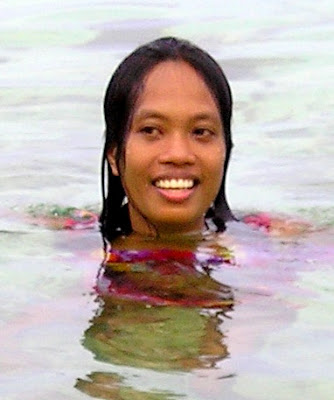 who continues to live up to my best expectations,
but I've acquired a puppy as well:

His name is Shiloh (named by Shedney after Angelina Jolie's new baby - where has all the native Filipino culture gone?), before she knew its sex(where has all the native Filipino folk-knowledge gone?), so I've renamed it Cielo - Spanish for heaven.
He's a cross between a Golden Retriever and something else. Both of them are going to need a few weeks rigourous training.
But they do seem to happen all at once:
Not only do I now have a lovely 'temporary wife'
 who continues to live up to my best expectations,
but I've acquired a puppy as well:

His name is Shiloh (named by Shedney after Angelina Jolie's new baby - where has all the native Filipino culture gone?), before she knew its sex(where has all the native Filipino folk-knowledge gone?), so I've renamed it Cielo - Spanish for heaven.
He's a cross between a Golden Retriever and something else. Both of them are going to need a few weeks rigourous training.
Thursday, 13 September 2007
Naming of the Parts: Pisangan Reef
I really shouldn't have been so surprised that the local people here in General Luna know their reef, and have a mental map of it. I can't translate all the names, but I can tell you that Daku na pasang is the high bit, and Gamay na pasang, the low bit. Taiwan commemmorates a local shipwreck, and Sabangan means reef passage. The main reef passage goes out to the Payaw, a fish attractor far out to sea, where the Payaw Men troll for bolis (skipjack tuna).
 It's a very useful food source; at every full moon, when the spring tide is low at midday, whole families go out there to scavenge for fresh seafood. You can see some of what they get here and here and here
Not all of those foods come from Pisangan (alimango, shrimps, etc, come from the mangroves) but most of them do.
And all of them are delicious. The scavengers pass by every so often, selling tajum (sea urchins), saliwake (another sea urchin), ganga (spider conch), lato (Philippine Caviare) etc. They would cost a small fortune in a Parisian seafood restaurant, but here we get them very cheaply indeed, usually by the glass (a half-pint empty Nescafe jar) or by the Caltex (a pint plastic oil can).
Straight out of the sea, onto the table; what could be better?

Not all of those foods come from Pisangan (alimango, shrimps, etc, come from the mangroves) but most of them do.
And all of them are delicious. The scavengers pass by every so often, selling tajum (sea urchins), saliwake (another sea urchin), ganga (spider conch), lato (Philippine Caviare) etc. They would cost a small fortune in a Parisian seafood restaurant, but here we get them very cheaply indeed, usually by the glass (a half-pint empty Nescafe jar) or by the Caltex (a pint plastic oil can).
Straight out of the sea, onto the table; what could be better?
Saturday, 8 September 2007
Revisiting a Shipwreck
It's always a bit sentimental when an old sea salt like me (who couldn't sail a plastic boat in a bath tub) goes back to the scene of a notorious shipwreck.
It happened 10 years ago, when Willie and Pedro got up a bunch of us newly-arrived tourists for a trip to Sohoton Cove. It's a 4 hour trip, but Sohoton is a magical place; a completely enclosed tidal lake in a spectacular limestone karst area, sealed off from the outside world by a a natural cave tunnel, hanging with stalactites, and with a strong current.
The lake is overhung by jungle cliffs, where you can swim into caves with bats, strange fish, stalactites and rock oysters, and see weird corals, pitcher plants, cycads and wild orchids.
As expected, it was a wonderful trip, and things only really began to go wrong on the way home. We stopped off at Socorro, on Bucas Grande Island, for some more petrol, and Willie and Pedro took some refreshment. We left Socorro very much too late to reach home before dark.
About halfway, as it was getting dark, it started to rain, and the breeze began to get a bit fresher. Willie and Pedro kept their boats close together, within sight, or at least within calling distance (bancas like these don't carry navigation lights).
Suddenly, another totally unlit banca came in, full-frontal, between the two boats, and W & P panicked, veering off in different directions.
By now, it was pitch dark, and blowing up a considerable storm. We, in Willie's boat, tacked across a huge area trying to find Pedro.
There wasn't a hope in the darkness, rain and wind, and then something silly happened; the rubber band that tensioned the petrol feed, and controlled the engine speed, broke, and we found ourselves unable to control the accelerator. We could see a faint line of hills on the horizon, so we headed for it, full speed ahead.
We hit the reef at maximum speed; the propellor was ripped off, and we surfed, free-style, right over the reef into the shallow lagoon beyond.
We had no idea where we were, but traipsed, wet, miserable, and cold, along the beach, eventually finding ourselves in Union, the next small town down the coast from General Luna.
I visited Union with Shedney yesterday, and for sentimental reasons, went to the point where we were washed up. In spite of a bright sunny day, the impenetrable mangrove clumps and rock-strewn shallow water were just as horrible as they were that night. You might just be able to make out the surf line of the reef, about half a mile out:

It happened 10 years ago, when Willie and Pedro got up a bunch of us newly-arrived tourists for a trip to Sohoton Cove. It's a 4 hour trip, but Sohoton is a magical place; a completely enclosed tidal lake in a spectacular limestone karst area, sealed off from the outside world by a a natural cave tunnel, hanging with stalactites, and with a strong current.

The lake is overhung by jungle cliffs, where you can swim into caves with bats, strange fish, stalactites and rock oysters, and see weird corals, pitcher plants, cycads and wild orchids.
As expected, it was a wonderful trip, and things only really began to go wrong on the way home. We stopped off at Socorro, on Bucas Grande Island, for some more petrol, and Willie and Pedro took some refreshment. We left Socorro very much too late to reach home before dark.
About halfway, as it was getting dark, it started to rain, and the breeze began to get a bit fresher. Willie and Pedro kept their boats close together, within sight, or at least within calling distance (bancas like these don't carry navigation lights).
Suddenly, another totally unlit banca came in, full-frontal, between the two boats, and W & P panicked, veering off in different directions.
By now, it was pitch dark, and blowing up a considerable storm. We, in Willie's boat, tacked across a huge area trying to find Pedro.
There wasn't a hope in the darkness, rain and wind, and then something silly happened; the rubber band that tensioned the petrol feed, and controlled the engine speed, broke, and we found ourselves unable to control the accelerator. We could see a faint line of hills on the horizon, so we headed for it, full speed ahead.
We hit the reef at maximum speed; the propellor was ripped off, and we surfed, free-style, right over the reef into the shallow lagoon beyond.
We had no idea where we were, but traipsed, wet, miserable, and cold, along the beach, eventually finding ourselves in Union, the next small town down the coast from General Luna.
I visited Union with Shedney yesterday, and for sentimental reasons, went to the point where we were washed up. In spite of a bright sunny day, the impenetrable mangrove clumps and rock-strewn shallow water were just as horrible as they were that night. You might just be able to make out the surf line of the reef, about half a mile out:

Good Things Happen Sometimes
About 4pm last Sunday, a young lady came to see me. We'd met a few days before, at Nine Bar, just down the road, where she told me she was looking so sad because the obnoxious, loud Australian making an egregious nuisance of himself at the other side of the room was her boyfriend. On Sunday, she came to me for some more some sympathy.
Yesterday I was driving, fairly carelessly, (a rented pick-up, for the first time in a year) when we hit a ramp between a newly-concreted stretch of road and the old rock/gravel/sand surface, just a little too fast. The poor girl was thrown up into the air, hit both the windscreen and ceiling, and came back down with a noticeable frown. Two minutes later, she was smiling again, and pointing out flowers and trees along the way.
Right now, she's making lambay (swimmer crab) pancakes. We got the crabs from her mother, in Union, a small town just down the coast; you have to get there by a roundabout route, because the bridge across the entrance to the mangroves has not been repaired for more than 20 years.
| Well, what could I do, but invite her to take refuge? She's been here ever since. Her name is quite unique; Shedney; but then Filipino names are often a little eccentric. But she's a delight; a very modest young lady, who really can cook, and smiles continuously, with wonderfully large eyes. Yes, I'm sure she's got a bad side, somewhere, but I haven't seen it yet. |  |
Yesterday I was driving, fairly carelessly, (a rented pick-up, for the first time in a year) when we hit a ramp between a newly-concreted stretch of road and the old rock/gravel/sand surface, just a little too fast. The poor girl was thrown up into the air, hit both the windscreen and ceiling, and came back down with a noticeable frown. Two minutes later, she was smiling again, and pointing out flowers and trees along the way.
Right now, she's making lambay (swimmer crab) pancakes. We got the crabs from her mother, in Union, a small town just down the coast; you have to get there by a roundabout route, because the bridge across the entrance to the mangroves has not been repaired for more than 20 years.
 | And the reason she's getting a corn-row hairdo from Eyeh the bayut? Well, I happened to come across a picture of one of those wonderful Benin bronze heads just the very same day, that reminded me of someone. |
Monday, 3 September 2007
Why I Care About Tsunamis
Our lagoon here at General Luna, Siargao Island, is roughly the same size as the one at Sissano, in North Papua New Guinea, and the geological and tectonic conditions are very similar, so if I wake up at night worriedly thinking 'What was that noise?' I'm not being paranoid.
 The town of General Luna is just to the right of top centre. I live a couple of hundred yards along on the coastal road that leads East, and then North to Cloud 9, the famous surfing wave. Daku is the big island on the South side of the lagoon, Guyam is the little dot, about halfway between Daku and the town, and Pisangan, the main reef, extends north from the entrance to the lagoon just north of Daku.
 The town of General Luna is just to the right of top centre. I live a couple of hundred yards along on the coastal road that leads East, and then North to Cloud 9, the famous surfing wave. Daku is the big island on the South side of the lagoon, Guyam is the little dot, about halfway between Daku and the town, and Pisangan, the main reef, extends north from the entrance to the lagoon just north of Daku.
About 50km over to the right is the Philippine Trench, 10,000 metres deep (you could dump Mt Everest out there, but you would still need a kilometre of rope to drop anchor on the summit). Our 'continental shelf' extends just to the seaward side of the reef; from there the seabed drops away sharply.
A seabed slump or landslide, like that at Sissano, is all it would need to wipe us all way, especially if, as in the case of Sissano, it involved what seems to have been a catastrophic release of sub-seabed clathrates, a reservoir of water-bound methane ice that can suddenly be released as an explosive gas. Hence the bubbles, the haze, and the strange glow at Sissano.
But not to worry. Our valiant government is doing what it can to advise us of what to do if it ever happens. They've put these two signs up in town, promininently near the public market and the seashore Boulevard.
 So, not to worry; and while you're running in a state of sheer blind panic past the evacuation route sign, do please take note that the . has fallen off, and it's only 1.4km, not 14, to the nearest high ground.
Sissano Lagoon 1998
This is what happened to Sissano Lagoon and its inhabitants on the evening of 17 July 1998. Such disasters, or similar ones, happen regularly to coastal areas anywhere, and have quite random, but devastating effects. It's almost as if the Earth and the Sea are casually swatting a few irritants.
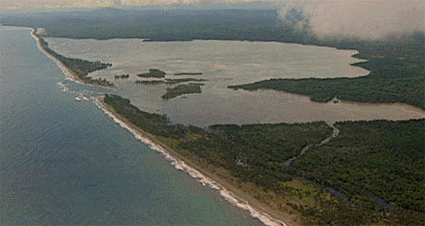
This is an area of low-lying coastal plain broken by isolated hills of basement rocks: Oligocene volcanic arc rocks and associated limestone. Further inland, foothills give way to the steep-fronted Bewani and Torricelli ranges. The coastal plain is bounded seaward by a coastal sand barrier that stands 1-2 m above sea level and is typically a few hundred meters across. The sand barrier is highest at the beachfront and slopes gently downwards away from the sea -- a common morphology for coastlines where sea level is rising relative to the land, and where there is a steady supply of sand distributed along the coast by longshore drift. Much of the sand barrier is planted with coconut palms and there are occasional large trees (kalopilam Callophylum inophyllum; breadfruit or kapiak Atocarpus altissima; talis Terminalia catappa; and mango Magnifera indica) and thickets of yar (Casuarina equisetifolia).
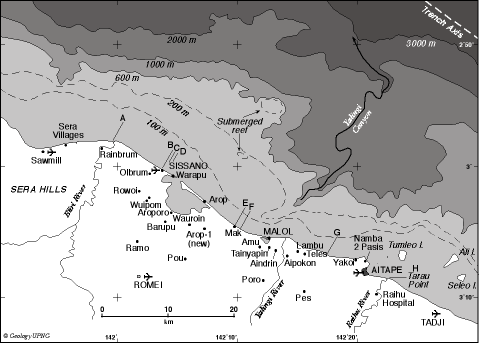
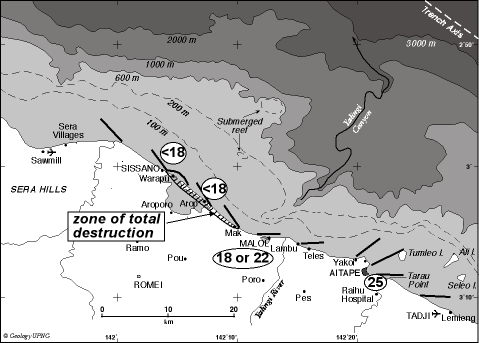
On the evening of 17 July 1998, on the Aitape coast of Papua New Guinea, a strongly felt earthquake was followed some 10-25 minutes later by a destructive tsunami. The tsunami comprised three waves, each estimated to be about 4 m high. The second of the three waves rose to a height of 10-15 m above sea level after it had crossed the shoreline and caused most damage. Maximum wave heights and greatest damage were recorded along a 14-km sector of coast centered on Sissano Lagoon. In this sector the wave fronts moved from east to west along the coast; all structures were destroyed, and 20-40 percent of the population was killed. Partial destruction extended 23 km to the southeast and 8 km to the northwest, and effects of the tsunami were felt as far as 250 km to the west-northwest, beyond the international border. More than 1600 people are known to have died, with some estimates as high as 2200; 1000 were seriously injured, and 10,000 survivors were displaced.
Before the tsunami, about 12,000 people lived in the coastal villages west of Aitape, from Malol to Sissano. Most houses were of traditional materials, and most were within a few hundred meters of the waterfront and on land that was not more than a few metros above sea level. Each village extended for a kilometer or more along the coast.
The main shock was sufficiently vigorous and prolonged that at Malol, Arop and Warapu people left their houses and moved into open space. At Arop and Warapu cracks opened in the ground, and water squirted upwards, house foundation posts shook and water rose around the posts, and there was a smell of hydrogen sulfide. At Sissano Mission the earthquake caused minor damage to the 62-year-old church, and in the nearby villages some houses collapsed. At Malol the shaking was strong enough to cause concern that the water tanks at the Mission might collapse. At Vanimo, 140 km from the epicenter, the earthquake was described by one long term resident as stronger and more prolonged than any he had experienced.
The main shock was followed, some minutes later, by a loud boom, as though of thunder; this was heard from Sissano to Malol. A few minutes or up to five minutes later there was a roaring sound, variously described as the noise of a low-flying heavy jet plane, the approach of a large ship, or as the woop-woop-woop of a heavy helicopter. The sound progressed eastward along the coast then back again to the west, and was heard all along the coast from Sissano in the west to Aitape High School in the east.
Although the sun had set at 6.37 pm, there was still sufficient daylight that the day's activities were continuing. Men were painting a canoe, young people were playing touch football and their elders were moving around in the villages. People went to the beach to investigate the unusual noise and observed that the sea was 'boiling' or bubbling, and had receded by 50 m or so, exposing the nearshore sea bed. They then saw a wave develop in the distance, as a dark line on a sea surface that otherwise reflected the light of the sky. The wave approached and, when 200-300 m from the beach, started to break, rolling from the top. 'Smoke' or haze rose from the top of the wave, and many saw a red glow in the top of the wave.
One observer (John Sanawe, a former Colonel in the PNG Defense Force) reported that he first saw the sea on the skyline rise and explode, sending spray high in the air where it caught and diffracted the late afternoon sunlight into rainbow colors. He then heard a sound like distant thunder. He wondered at hearing thunder on a day when the sky was clear, then linked this sound to the explosion. Then there was a sound like a heavy helicopter, or such as can be heard when a bottle is held under water, and the sea started to retreat from the shore. The rhythm of the helicopter noise slowed as the retreat of the sea slowed. Then there was silence for 4-5 minutes, followed by the noise of a low-flying jet aircraft. Sanawe looked to sea and saw that a wave had formed at or near the site of the explosion. The wave then approached at great speed.
People ran from the approaching waves but almost all were caught. A few escaped by climbing trees, or pushing their boats into the lagoon.
People in the waves were vigorously tumbled and turned in water that was laden with sand and debris. They were stripped of their clothing, lost skin by sand abrasion, were battered by hard objects and some cut or impaled by timber and metal objects. Those who were fortunate were carried into the lagoon and were able to cling to floating debris. An infant was deposited miraculously on the floating roof of a house. Those less fortunate were carried into swampland or into the mangroves that fringe the lagoon where some were impaled or were buried under piles of logs and debris. Some who had survived the initial impact were swept out to sea as the waters receded. Most had ingested water from the waves.
Wave heights, on shore, were 10-15 m above sea level and there was extensive damage for distances of up to 500 m from the coast. Damage was less on either side of a 14-km sector.
 By 7.20 or 7.25 pm the water had retreated, though much standing water remained. At this moment, according to survivors, the sky was filled with a yellow or yellow-red glow that provided sufficient light for people to start searching for family members. They said that without the glow this would not have been possible.
At Sissano Lagoon a low haze had advanced with the wave and this now blotted out the stars, so that it became pitch dark, so dark that people moving inland, away from the lagoon, held on to each other to maintain contact.
Rescue began that night, the survivors helping each other. The first outside help arrived 16 hours after the event on the Saturday morning, and a major rescue effort began a day later, 40 hours after the event.
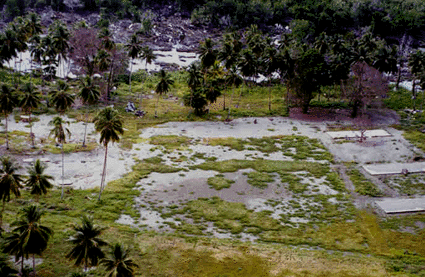 Three concrete slabs (right) are all that remained of the class rooms at Warapu school.
Amazingly, the coconut trees mostly survived.
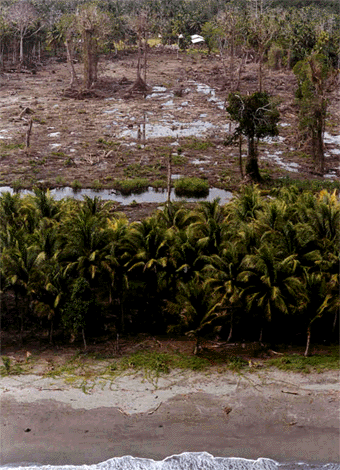 This photo, taken from the sea's edge, at Arop village, shows the destruction inland of the belt of coconut palms at the top of the beach.
And there were other horrors accopanyng the waves, which arrived just after dusk:
John Kimene of Nimas was one of a group that was fishing at a drowned reef 8-10 km from the coast at about 10 am on Thursday 16 July 1998. This probably is the reef marked on the map just inside the 200 m isobath, which stands at 82 m depth. As the party trolled 1-2 km west of the submerged reef they were surprised to run into a succession of 2-3 m waves that loomed and steepened as though about to break. They took this to be evidence of a new shoaling of the water in an area that previously had been quite deep. There was a smell of dead fish.
On Friday 17 July 1998 at about noon Tom Kaisiera, a teenager from Nimas, paddled to the same general area and was surprised to find the sea bubbling with odorless gas. The area of bubbling was large, perhaps 100-200 m across. The canoe was drawn toward the center of bubbling area and it was only by paddling strongly that he could escape.
Three unusual lighting effects were reported. Many observers saw a red light on the horizon before the tsunami developed: "After the first earthquake, a long streak of red light like fire appeared just above the ocean on northern horizon, it flashed and then disappeared, then within seconds there was a loud bang". Also, many observers described a red glow or "fire" in the top of the wave.
After the wave passed, observers at widely separated locations (Warapu, Malol and Raihu) saw a yellow or yellow-red glow in the sky over the sea. "The sky lit up after the wave had destroyed the villages" (observer at Malol) and "after I climbed down from the tree I saw a big light over Arop and in the direction of Aitape" (observer on an island near the lagoon mouth). The Sisters at Malol recall that after the waves had passed they looked seaward and saw a calm golden sea. Warapu survivors recall that the yellow glow in the sky helped light their search for survivors.
I'm indebted to the following excellent report for the pictures and descriptions:
The Aitape 1998 tsunami: Reconstructing the event from interviews and field mapping.
This is an area of low-lying coastal plain broken by isolated hills of basement rocks: Oligocene volcanic arc rocks and associated limestone. Further inland, foothills give way to the steep-fronted Bewani and Torricelli ranges. The coastal plain is bounded seaward by a coastal sand barrier that stands 1-2 m above sea level and is typically a few hundred meters across. The sand barrier is highest at the beachfront and slopes gently downwards away from the sea -- a common morphology for coastlines where sea level is rising relative to the land, and where there is a steady supply of sand distributed along the coast by longshore drift. Much of the sand barrier is planted with coconut palms and there are occasional large trees (kalopilam Callophylum inophyllum; breadfruit or kapiak Atocarpus altissima; talis Terminalia catappa; and mango Magnifera indica) and thickets of yar (Casuarina equisetifolia).
On the evening of 17 July 1998, on the Aitape coast of Papua New Guinea, a strongly felt earthquake was followed some 10-25 minutes later by a destructive tsunami. The tsunami comprised three waves, each estimated to be about 4 m high. The second of the three waves rose to a height of 10-15 m above sea level after it had crossed the shoreline and caused most damage. Maximum wave heights and greatest damage were recorded along a 14-km sector of coast centered on Sissano Lagoon. In this sector the wave fronts moved from east to west along the coast; all structures were destroyed, and 20-40 percent of the population was killed. Partial destruction extended 23 km to the southeast and 8 km to the northwest, and effects of the tsunami were felt as far as 250 km to the west-northwest, beyond the international border. More than 1600 people are known to have died, with some estimates as high as 2200; 1000 were seriously injured, and 10,000 survivors were displaced.
Before the tsunami, about 12,000 people lived in the coastal villages west of Aitape, from Malol to Sissano. Most houses were of traditional materials, and most were within a few hundred meters of the waterfront and on land that was not more than a few metros above sea level. Each village extended for a kilometer or more along the coast.
The main shock was sufficiently vigorous and prolonged that at Malol, Arop and Warapu people left their houses and moved into open space. At Arop and Warapu cracks opened in the ground, and water squirted upwards, house foundation posts shook and water rose around the posts, and there was a smell of hydrogen sulfide. At Sissano Mission the earthquake caused minor damage to the 62-year-old church, and in the nearby villages some houses collapsed. At Malol the shaking was strong enough to cause concern that the water tanks at the Mission might collapse. At Vanimo, 140 km from the epicenter, the earthquake was described by one long term resident as stronger and more prolonged than any he had experienced.
The main shock was followed, some minutes later, by a loud boom, as though of thunder; this was heard from Sissano to Malol. A few minutes or up to five minutes later there was a roaring sound, variously described as the noise of a low-flying heavy jet plane, the approach of a large ship, or as the woop-woop-woop of a heavy helicopter. The sound progressed eastward along the coast then back again to the west, and was heard all along the coast from Sissano in the west to Aitape High School in the east.
Although the sun had set at 6.37 pm, there was still sufficient daylight that the day's activities were continuing. Men were painting a canoe, young people were playing touch football and their elders were moving around in the villages. People went to the beach to investigate the unusual noise and observed that the sea was 'boiling' or bubbling, and had receded by 50 m or so, exposing the nearshore sea bed. They then saw a wave develop in the distance, as a dark line on a sea surface that otherwise reflected the light of the sky. The wave approached and, when 200-300 m from the beach, started to break, rolling from the top. 'Smoke' or haze rose from the top of the wave, and many saw a red glow in the top of the wave.
One observer (John Sanawe, a former Colonel in the PNG Defense Force) reported that he first saw the sea on the skyline rise and explode, sending spray high in the air where it caught and diffracted the late afternoon sunlight into rainbow colors. He then heard a sound like distant thunder. He wondered at hearing thunder on a day when the sky was clear, then linked this sound to the explosion. Then there was a sound like a heavy helicopter, or such as can be heard when a bottle is held under water, and the sea started to retreat from the shore. The rhythm of the helicopter noise slowed as the retreat of the sea slowed. Then there was silence for 4-5 minutes, followed by the noise of a low-flying jet aircraft. Sanawe looked to sea and saw that a wave had formed at or near the site of the explosion. The wave then approached at great speed.
People ran from the approaching waves but almost all were caught. A few escaped by climbing trees, or pushing their boats into the lagoon.
People in the waves were vigorously tumbled and turned in water that was laden with sand and debris. They were stripped of their clothing, lost skin by sand abrasion, were battered by hard objects and some cut or impaled by timber and metal objects. Those who were fortunate were carried into the lagoon and were able to cling to floating debris. An infant was deposited miraculously on the floating roof of a house. Those less fortunate were carried into swampland or into the mangroves that fringe the lagoon where some were impaled or were buried under piles of logs and debris. Some who had survived the initial impact were swept out to sea as the waters receded. Most had ingested water from the waves.
Wave heights, on shore, were 10-15 m above sea level and there was extensive damage for distances of up to 500 m from the coast. Damage was less on either side of a 14-km sector.
By 7.20 or 7.25 pm the water had retreated, though much standing water remained. At this moment, according to survivors, the sky was filled with a yellow or yellow-red glow that provided sufficient light for people to start searching for family members. They said that without the glow this would not have been possible.At Sissano Lagoon a low haze had advanced with the wave and this now blotted out the stars, so that it became pitch dark, so dark that people moving inland, away from the lagoon, held on to each other to maintain contact.
Rescue began that night, the survivors helping each other. The first outside help arrived 16 hours after the event on the Saturday morning, and a major rescue effort began a day later, 40 hours after the event.
Three concrete slabs (right) are all that remained of the class rooms at Warapu school.Amazingly, the coconut trees mostly survived.
This photo, taken from the sea's edge, at Arop village, shows the destruction inland of the belt of coconut palms at the top of the beach.And there were other horrors accopanyng the waves, which arrived just after dusk:
John Kimene of Nimas was one of a group that was fishing at a drowned reef 8-10 km from the coast at about 10 am on Thursday 16 July 1998. This probably is the reef marked on the map just inside the 200 m isobath, which stands at 82 m depth. As the party trolled 1-2 km west of the submerged reef they were surprised to run into a succession of 2-3 m waves that loomed and steepened as though about to break. They took this to be evidence of a new shoaling of the water in an area that previously had been quite deep. There was a smell of dead fish.
On Friday 17 July 1998 at about noon Tom Kaisiera, a teenager from Nimas, paddled to the same general area and was surprised to find the sea bubbling with odorless gas. The area of bubbling was large, perhaps 100-200 m across. The canoe was drawn toward the center of bubbling area and it was only by paddling strongly that he could escape.
Three unusual lighting effects were reported. Many observers saw a red light on the horizon before the tsunami developed: "After the first earthquake, a long streak of red light like fire appeared just above the ocean on northern horizon, it flashed and then disappeared, then within seconds there was a loud bang". Also, many observers described a red glow or "fire" in the top of the wave.
After the wave passed, observers at widely separated locations (Warapu, Malol and Raihu) saw a yellow or yellow-red glow in the sky over the sea. "The sky lit up after the wave had destroyed the villages" (observer at Malol) and "after I climbed down from the tree I saw a big light over Arop and in the direction of Aitape" (observer on an island near the lagoon mouth). The Sisters at Malol recall that after the waves had passed they looked seaward and saw a calm golden sea. Warapu survivors recall that the yellow glow in the sky helped light their search for survivors.
I'm indebted to the following excellent report for the pictures and descriptions:
The Aitape 1998 tsunami: Reconstructing the event from interviews and field mapping.
Sunday, 2 September 2007
Nine Bar
Some people's definition of paradise is to live on a small tropical island, with waving palm trees, white sand beaches, a lapping sea that is is as clear, blue, warm, and inviting as an elephant's eye, with friendly native people....and so on....and on.
Well, I tend to agree with them.
Especially if a couple of friends open a very cosy, friendly little bar just 100 metres down the road from my house.

I've known plenty of hopefuls who've tried to do the same (I did myself, and will tell the horror story sometime), but these fellows (Peter, Pontus & Frida, from Sweden) got it right.
They hadn't a clue about bars, and were very new to the locals. By chance, they hit on exactly the right group to operate their new enterprise.
Otherwise they would have been robbed blind, and the bar would have closed within a month or so.
 Diding, Adie, and Maddie were the perfect crew. Diding and Adie used to make beads for me. Diding kept the books, and was paymaster. She's wholly and utterly trustworthy, and that's a rare commodity anywhere.
It's only a coco cabin, 2 storey, with an apartment and balcony above, and a 15ft x 15ft room, open on three sides, below, perfectly placed at the beginning of what is becoming a smart suburb (Acacia Avenue) of a new ribbon development of foreigners' houses leading out to Cloud 9, the surfing spot.
But it's worked, which is the only reason I'm telling this story.
Mind you, the prices are very high: a small beer is P40 (40p or 80c), a junior lapad bottle of rum is P50, and a generous shot of Chivas Regal or some of those strange Swedish Akvavits that Peter and Frida acquire from somewhere cost almost $2 a shot.
And you can see who's there from the outside:

In short, it's the perfect neighbourhood bar.
I do hope it lasts.

Well, I tend to agree with them.
Especially if a couple of friends open a very cosy, friendly little bar just 100 metres down the road from my house.

I've known plenty of hopefuls who've tried to do the same (I did myself, and will tell the horror story sometime), but these fellows (Peter, Pontus & Frida, from Sweden) got it right.
They hadn't a clue about bars, and were very new to the locals. By chance, they hit on exactly the right group to operate their new enterprise.
Otherwise they would have been robbed blind, and the bar would have closed within a month or so.
 Diding, Adie, and Maddie were the perfect crew. Diding and Adie used to make beads for me. Diding kept the books, and was paymaster. She's wholly and utterly trustworthy, and that's a rare commodity anywhere.
It's only a coco cabin, 2 storey, with an apartment and balcony above, and a 15ft x 15ft room, open on three sides, below, perfectly placed at the beginning of what is becoming a smart suburb (Acacia Avenue) of a new ribbon development of foreigners' houses leading out to Cloud 9, the surfing spot.
But it's worked, which is the only reason I'm telling this story.
Mind you, the prices are very high: a small beer is P40 (40p or 80c), a junior lapad bottle of rum is P50, and a generous shot of Chivas Regal or some of those strange Swedish Akvavits that Peter and Frida acquire from somewhere cost almost $2 a shot.
And you can see who's there from the outside:

In short, it's the perfect neighbourhood bar.
I do hope it lasts.
Sunday, 26 August 2007
Atlas Moth
This morning, I had a much more welcome insect visitor to the house than the usual mosquitoes, coconut beetles, and the 'mad bomber' May beetles,which fly, at great speed, and very noisily, from one vertical surface to another, knocking themselves out as they do so.

It's an Atlas moth, of the saturnid group, and is gigantic; you can see from my photo just how large and beautiful it is.
I don't know the exact species; the Wikipedia page shows another species as Attacus atlas, but at the foot of the page, quite a few photos of another moth, identical to this one.
But it does mention that in Canton, the local name is Snake's Head Moth, and perhaps you can see why. You can see a definite snake image at either side of each wing, glaring fiercely to left and right.
As it happened by lucky coincidence, I was, just last night, idly browsing through:
In the Blink of an Eye: How Vision Kick-started the Big Bang of Evolution - by Andrew Parker (no relation), where he discusses the snake's head.
He says that ultra-violet light, particularly strong in mid-day sunshine, when moth-eating birds are around, actually intensifes the snake's head image at the expense of the other wing-pattern elements, which really come into their own as protective camouflage in other lighting conditions.
Many birds and insects can perceive ultra-violet light reflections, which we can't, quite so well. Many flowers, that look dull to us, show an ultra-violet light patterning that is positively like a reflective direction sign to a nectar-seeking bee.
In other words, this moth has actually evolved mimicry of an attacking snake for some light conditions, and mimicry of an bit of old tree bark or forest floor for others, which is quite a subtle and wondrous thing to do.
The other wondrous thing about this moth is that it has no mouth parts, so cannot eat anything at all during its adult life. It survives, for about two weeks, entirely on its puppy fat, while it flies gracefully around the forest, looking for a mate before it dies.
Makes you wonder, doesn't it, if the adult moth is the 'real' animal, or if the caterpillar, which is itself quite remarkable, is the 'real thing'.

It's an Atlas moth, of the saturnid group, and is gigantic; you can see from my photo just how large and beautiful it is.
I don't know the exact species; the Wikipedia page shows another species as Attacus atlas, but at the foot of the page, quite a few photos of another moth, identical to this one.
But it does mention that in Canton, the local name is Snake's Head Moth, and perhaps you can see why. You can see a definite snake image at either side of each wing, glaring fiercely to left and right.
As it happened by lucky coincidence, I was, just last night, idly browsing through:
In the Blink of an Eye: How Vision Kick-started the Big Bang of Evolution - by Andrew Parker (no relation), where he discusses the snake's head.
He says that ultra-violet light, particularly strong in mid-day sunshine, when moth-eating birds are around, actually intensifes the snake's head image at the expense of the other wing-pattern elements, which really come into their own as protective camouflage in other lighting conditions.
Many birds and insects can perceive ultra-violet light reflections, which we can't, quite so well. Many flowers, that look dull to us, show an ultra-violet light patterning that is positively like a reflective direction sign to a nectar-seeking bee.
In other words, this moth has actually evolved mimicry of an attacking snake for some light conditions, and mimicry of an bit of old tree bark or forest floor for others, which is quite a subtle and wondrous thing to do.
The other wondrous thing about this moth is that it has no mouth parts, so cannot eat anything at all during its adult life. It survives, for about two weeks, entirely on its puppy fat, while it flies gracefully around the forest, looking for a mate before it dies.
Makes you wonder, doesn't it, if the adult moth is the 'real' animal, or if the caterpillar, which is itself quite remarkable, is the 'real thing'.
Subscribe to:
Posts (Atom)